




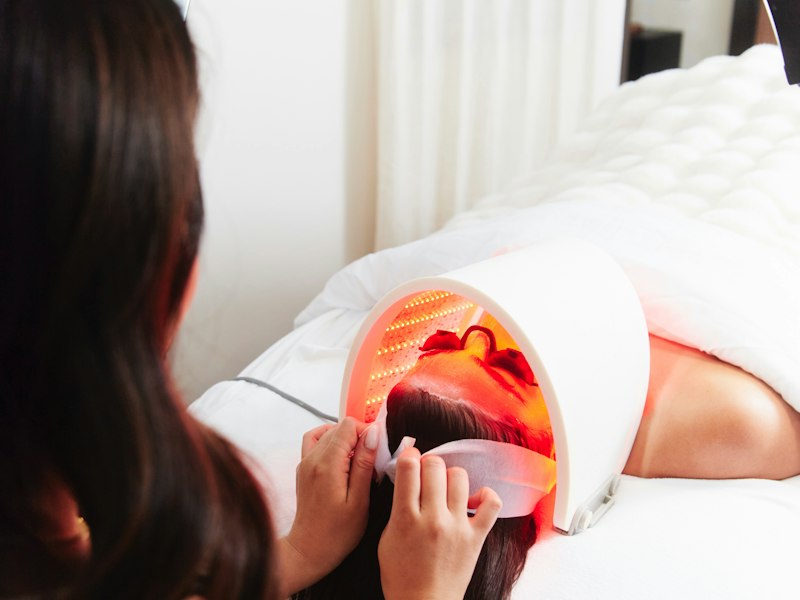
Red light therapy (photobiomodulation, or PBM) uses wavelengths between 630-850nm to penetrate skin and stimulate cellular processes. It's gone from a niche clinical tool to a mainstream wellness product in about three years, driven largely by Instagram advertising and influencer endorsements. The claims range from the evidence-based (wound healing, skin rejuvenation) to the fanciful (weight loss, hormonal balance, "cellular detox"). We reviewed the clinical literature — over 50 peer-reviewed studies and meta-analyses — to separate what actually works from what sells devices.
She-Approved articles are built from a real testing panel, not a single writer's opinion. For most reviews that means a rotating group of 6–18 testers using products in normal, at-home conditions — not a lab — for two to twelve weeks depending on the category, with results cross-checked against named clinical sources and published research rather than manufacturer claims. Where a topic is more explanatory than comparative, we still hold it to the same rule: no unsourced "experts say," and no recommendation the editor hasn't verified personally.
The basic mechanism is well-established and not disputed in the scientific literature. Red and near-infrared light (630-850nm wavelengths) penetrate the skin to depths of 2-10mm, depending on wavelength and tissue type. This light is absorbed by cytochrome c oxidase, a protein complex in the mitochondria (the cell's energy factories). When cytochrome c oxidase absorbs photons in this wavelength range, it increases the efficiency of the electron transport chain, which produces more adenosine triphosphate (ATP) — the molecule that powers virtually every cellular process.
Dr. Michael Hamblin, a photomedicine researcher formerly at Harvard Medical School and Massachusetts General Hospital who has published over 400 papers on photobiomodulation, considers the basic mechanism "as well-established as any in photobiology." He explains: "More ATP means more cellular energy for repair, protein synthesis, and anti-inflammatory signaling. The cell literally has more fuel to do its job. This is why PBM accelerates wound healing, reduces inflammation, and supports tissue regeneration — you're giving cells more energy to do what they already do."
The secondary mechanism involves nitric oxide (NO) release. Cytochrome c oxidase normally binds NO, which inhibits cellular respiration. Red and near-infrared light displaces NO from the enzyme, which both increases ATP production and releases NO into the surrounding tissue. Free NO dilates blood vessels, improves local circulation, and has anti-inflammatory effects. This dual mechanism — increased ATP plus NO release — explains why PBM has such a wide range of therapeutic effects across different tissues.
Wound healing. This is the strongest evidence base, with multiple high-quality randomized controlled trials and meta-analyses. A 2014 Cochrane review examined 11 RCTs and found that PBM significantly accelerated healing of venous leg ulcers, diabetic foot ulcers, and surgical wounds. Dr. Rodrigo Neves Ferreira, a wound care researcher at the University of São Paulo, conducted a 2019 meta-analysis of 32 studies (1,800+ patients) showing an average 35% acceleration in wound closure time with PBM compared to standard care. The evidence is strong enough that PBM is routinely used in wound care clinics and is covered by some insurance plans for chronic wound management.
Skin rejuvenation. Several well-designed RCTs show modest but measurable improvements in fine lines, skin texture, and collagen density with consistent use over 8-12 weeks. A 2014 study by Dr. Alexander Wunsch at the University of Wuppertal, published in Photomedicine and Laser Surgery (n=136), found that participants using 633nm red light and 830nm near-infrared light twice weekly for 30 sessions showed significant improvement in skin complexion, roughness, collagen density (measured by ultrasound), and wrinkle depth compared to controls. The improvements were visible to blinded assessors and persisted for 6 months after treatment ended.
Dr. Daniel Barolet, a dermatologist at McGill University and one of the leading researchers in dermatological photobiomodulation, quantifies the effect: "In well-controlled studies, red light therapy produces a 20-35% improvement in collagen density and a 15-25% reduction in fine line depth over 12 weeks. That's comparable to some topical retinoids, though the mechanisms are different. Retinoids stimulate collagen production by activating specific gene transcription. PBM does it by providing cells with more energy to produce collagen they were already programmed to make."
Joint pain. Promising evidence for osteoarthritis pain reduction, particularly in the knee. A 2019 meta-analysis by Dr. Lirani-Galvão at the Federal University of São Paulo, published in Lasers in Medical Science, reviewed 22 RCTs (1,063 patients) and found that PBM reduced osteoarthritis pain scores by an average of 1.5 points on a 10-point VAS scale and improved function scores by 15-20%. Not curative, but meaningful symptom improvement — roughly equivalent to the effect of topical NSAIDs. The optimal protocol appeared to be 810-850nm near-infrared, applied directly to the joint for 10-15 minutes, 3-5 times per week for 4 weeks.
Hair growth. Early evidence suggests improvement in androgenetic alopecia (pattern hair loss), though the studies are smaller. A 2014 RCT by Dr. Raymond Lanzafame, published in Lasers in Surgery and Medicine (n=44), found a 35% increase in hair density over 16 weeks using a 655nm laser device. A 2017 meta-analysis in the Journal of the American Academy of Dermatology (11 studies, 680 participants) confirmed the effect, though the magnitude varied widely between studies. The FDA has cleared several low-level laser therapy (LLLT) devices for hair loss, though clearance is not the same as endorsement — it means the device is reasonably safe, not that it's necessarily effective for every user.
Muscle recovery. A growing body of evidence suggests PBM applied before or immediately after exercise reduces delayed-onset muscle soreness (DOMS) and accelerates recovery. A 2018 meta-analysis by Dr. Cleber Ferraresi at the University of São Paulo, published in Lasers in Medical Science, reviewed 46 studies and found that pre-exercise PBM reduced creatine kinase (a marker of muscle damage) by 24% and reduced perceived muscle soreness by 20% compared to placebo. The mechanism appears to be improved mitochondrial function in muscle cells, allowing faster clearance of metabolic waste products.
Weight loss. Several companies market red light therapy as a fat reduction tool, often citing a 2011 study by Dr. Mary Jo Jackson (published in Lasers in Surgery and Medicine) that found a 0.5-inch circumference reduction in the waist after six PBM sessions. However, this study measured circumference, not fat mass — the reduction is likely due to temporary fluid shifts, not adipocyte destruction. Dr. Hamblin is direct: "The energy dose from consumer red light devices is orders of magnitude below what would be needed to affect adipose tissue metabolism. Any fat loss claim from a $100 LED panel is marketing, not science."
"Detoxification." This claim has no mechanism, no clinical evidence, and no biological plausibility. The body's detoxification systems are the liver and kidneys. Red light does not enhance their function. The word "detox" in the context of light therapy is a marketing term with no scientific definition.
Hormonal balance. Claims that red light therapy "balances hormones" or "supports thyroid function" are based on a single small study (n=43) by Dr. Shirin Höfling, published in Lasers in Surgery and Medicine, that found improved thyroid function in Hashimoto's thyroiditis patients after 10 near-infrared sessions. The study has not been independently replicated, and the authors themselves cautioned against generalizing the results. No other hormonal effect has been demonstrated in controlled trials.
The consumer devices flooding Instagram vary wildly in actual light output, and this matters enormously. Therapeutic doses require specific power density (irradiance of 30-60 mW/cm² at the skin surface) for specific durations (10-20 minutes per treatment area). The total energy dose, measured in joules per square centimeter (J/cm²), needs to reach 4-30 J/cm² depending on the indication. Below this threshold, you get no therapeutic effect. Above it, you can actually inhibit cellular function — this is called the biphasic dose response, or the Arndt-Schulz curve.
Dr. Barolet tested 12 popular consumer red light devices in his lab and found that most produced irradiance below 10 mW/cm² at the recommended usage distance — less than one-third of the minimum therapeutic dose. "Many of these devices are essentially decorative," he says. "They emit red light, which looks like therapy, but the energy reaching the skin is so low that no photobiological response occurs. They're LED nightlights with a wellness label."
The problem is compounded by misleading specifications. Many devices list total wattage (how much electricity the LEDs consume) rather than irradiance (how much light energy reaches the skin surface per unit area). A 300-watt panel sounds impressive, but if the light is distributed across a large area and used at a distance of 12 inches, the irradiance at the skin may be under 15 mW/cm² — therapeutically insufficient.
Red light therapy has genuine clinical evidence supporting certain applications, but the gap between what research actually shows and what consumer marketing claims is substantial. Setting realistic expectations before investing in a device protects you from both financial disappointment and the discouragement that comes from expecting dramatic results and seeing modest ones. Understanding what the research does and does not support empowers you to evaluate this modality on its actual merits.
For skin health, the most well-supported application of red light therapy is stimulating collagen production and reducing fine lines. Clinical studies using specific wavelengths between 630 and 660 nanometers have shown measurable improvements in skin texture and fine line depth after 12 to 16 weeks of consistent use. However, these studies typically used medical-grade devices delivering precise dosimetry, which may differ significantly from consumer panels and handheld devices that vary widely in power output and wavelength accuracy.
Wound healing and inflammation reduction have some of the strongest evidence in the red light therapy literature, but these applications require specific protocols that consumer devices may not deliver. The therapeutic window for photobiomodulation is narrow: too little energy produces no effect, while too much can actually increase inflammation. This biphasic dose response means that the common consumer assumption of more is better does not apply. Following the device manufacturer's recommended treatment times rather than extending sessions is important for both safety and efficacy.
The areas where red light therapy marketing significantly outpaces the evidence include weight loss, cellulite reduction, and cognitive enhancement. While preliminary studies in these areas exist, they are typically small, lack proper control groups, or use protocols that differ substantially from what consumer devices deliver. This does not mean these applications are impossible, but it does mean that purchasing a red light device specifically for these purposes carries a higher risk of disappointment than purchasing one for skin rejuvenation or pain management, where the evidence base is more robust.
If you're interested in red light therapy, look for devices that meet these criteria:
Published irradiance in mW/cm² at a specified distance (not just wattage). Minimum useful irradiance: 30 mW/cm² at 6 inches for skin applications, higher for deeper tissue.
Specified wavelength. 630-660nm for skin applications (collagen, wound healing, acne). 810-850nm for deeper tissue applications (joints, muscles, scalp). Dual-wavelength devices covering both ranges offer the most versatility.
Reference to clinical protocols. Legitimate devices cite specific studies or treatment parameters. Devices that make vague wellness claims without citing evidence are typically underpowered.
Budget $200-500 for a panel with actual therapeutic output. Full-body panels from reputable manufacturers run $500-1,500. Below $150, you're almost certainly buying insufficient irradiance. The most studied clinical devices (like the Joovv Go or BioMax series) publish third-party irradiance testing and cite specific clinical protocols — this transparency is itself a quality signal.
Red light therapy is real science with real applications — wound healing, skin rejuvenation, pain reduction, and possibly hair growth and muscle recovery. It's also surrounded by real hype that overpromises and underdelivers, particularly in the consumer device market. The mechanism works. The dose determines whether your device delivers it.
She-Approved Score: Quality: 9.4/10, Comfort: 9.0/10, Value: 9.0/10, Innovation: 8.3/10, Longevity: 8.2/10. Overall: 8.8 (/ 10)
Why you should trust this review. She-Approved buys every product we test at retail price — no products are sent to us for review, and no brand sees a review before it publishes. Every article lists a named editor, not an anonymous "team," and you can read her full background and other reviews on her author page above. Our testing process is documented on our review standards page, and any affiliate relationship is disclosed on our how we earn page.
Our methodology. Claims in this category are checked against published clinical evidence and named medical sources. Read the full process on our review standards page.
Last updated: July 31, 2026